
How Much Fish is too Much?
Written by Madelyn Corsetti (student at the University of Rhode Island)
Do you ever worry about how much mercury might be coming from your fish? Many people in the U.S. eat fish regularly, yet most mercury guidelines focus only on pregnant women and children. These existing guidelines are important, because your body size determines how much mercury is safe for you, so smaller people, like children, can handle less mercury.
Fish are an excellent source of protein, packed with healthy omega-3 fats along with other vitamins and minerals that support brain, heart, and metabolic health (1). Omega-3’s help lower blood pressure, ease inflammation, and reduce the risk of stroke, depression, Alzheimer's disease, and other chronic conditions (2).
Eating foods with too much mercury is dangerous and can cause long-lasting damage, including speech impairment, loss of peripheral vision, and memory loss (3). Given this, you should not eat the maximum serving every day. Mercury can stay in your body for months.
The tables below were created using data from “Mercury levels in high-end consumers of fish”, which provides mercury safety limits (4). The basic information I used to create the tables includes:
Blood mercury should stay below 5.0 micrograms per liter
Hair mercury should stay below 1.0 micrograms per gram
You don’t want to consume more than 0.1 micrograms of mercury per kilogram of body weight per day
I calculated how much mercury is typically found in common fish, and how much you can eat safely based on your body weight (4). If you prefer not to know your weight, just pick a weight that seems fairly close and err on the side of smaller than you might be. Each chart assumes that this type of fish is your only mercury source.
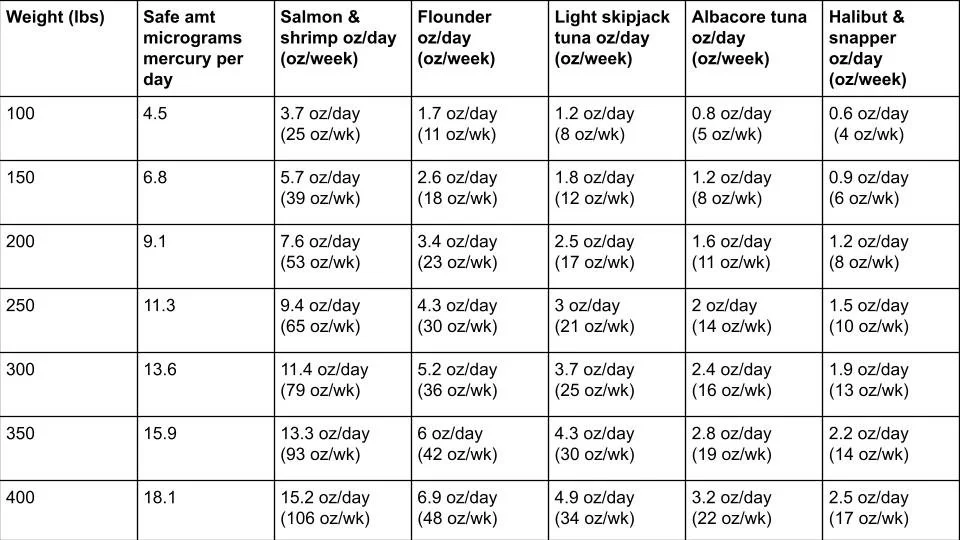
Notes:
*Salmon and shrimp were both calculated using shrimp’s average mercury levels, salmon contains slightly less mercury on average.
Ounces per week were rounded to the lower whole number for ease of reading
This article provides general information, but does not take into account any health conditions. In RI and MA, many health insurance plans cover meetings with a Registered Dietitian Nutritionist. You can contact Shira here or find another nutrition expert in your area here.
References
Gutierres, D., Pacheco, R., & Reis, C. P. (2025b). The Role of Omega-3 and Omega-6 Polyunsaturated Fatty Acid Supplementation in Human Health, 14(19), 3299. https://doi.org/10.3390/foods14193299
Zhang, X., Ritonja, J. A., Zhou, N., et al. (2022). Omega‐3 polyunsaturated Fatty Acids Intake and blood pressure: A dose‐response meta‐analysis of Randomized Controlled Trials. Journal of the American Heart Association, 11(11). https://doi.org/10.1161/jaha.121.025071
Environmental Protection Agency. (2025). Health Effects of Exposures to Mercury. EPA. https://www.epa.gov/mercury/health-effects-exposures-mercury
Hightower, J. M., & Moore, D. (2003a). Mercury levels in high-end consumers of fish. Environmental Health Perspectives, 111(4), 604–608. https://doi.org/10.1289/ehp.5837